A low waste skincare routine doesn’t require an empty bathroom cabinet. You definitely shouldn’t have a guilty conscience about everything already sitting in it. Instead, think of it as being more deliberate the next time something runs out. Start with whatever you go through fastest.
The best part of switching to low waste products? You don’t have to sacrifice function or performance to do it. Formulations have come a long way and Plastic Free July is as good a prompt as any to give one a proper try.
It’s important for me to point out that swapping one product isn’t going to fix the beauty industry’s packaging problem on its own. But, it’s a useful prompt to work out where the packaging in your routine comes from and which bits of it you could reasonably change.
What a Low Waste Skincare Routine Means
While I would love to say the opposite, nothing in skincare is zero waste. Raw ingredients still arrive in something (in my experience, usually plastic bottles, containers or bags). Finished products often require some form of container to stay safe, portable and usable. Even a bar wrapped in paper has a supply chain behind it.
What changes with solid products is the removal of one specific, high-volume source of waste: the bottle that gets thrown away every four to six weeks.
According to the British Beauty Council, 95% of cosmetic packaging from the beauty industry is thrown away rather than reused. Only a small proportion of what does get collected is recycled. So, reducing how much you go through in the first place is more effective than recycling alone.
The Three Swaps That Make the Biggest Difference
While you can swap everything in your bathroom to solid cosmetics or refillable options, for many of us, there is a balance to be struck. Some products get used sparingly and last months regardless of their format. Others can be swapped to a refillable option. The ones worth targeting first are the ones you replace frequently.
For most households, that’s three products:
- Shampoo
- Conditioner
- Body moisturiser
These are the things bought monthly, sometimes more often, almost always in a plastic bottle.
How Long do Low Waste Alternatives Last?
When I speak to my customers, those that are considering low waste alternatives are amazed at the numbers. Let’s break it down for context:
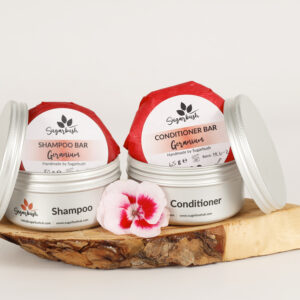
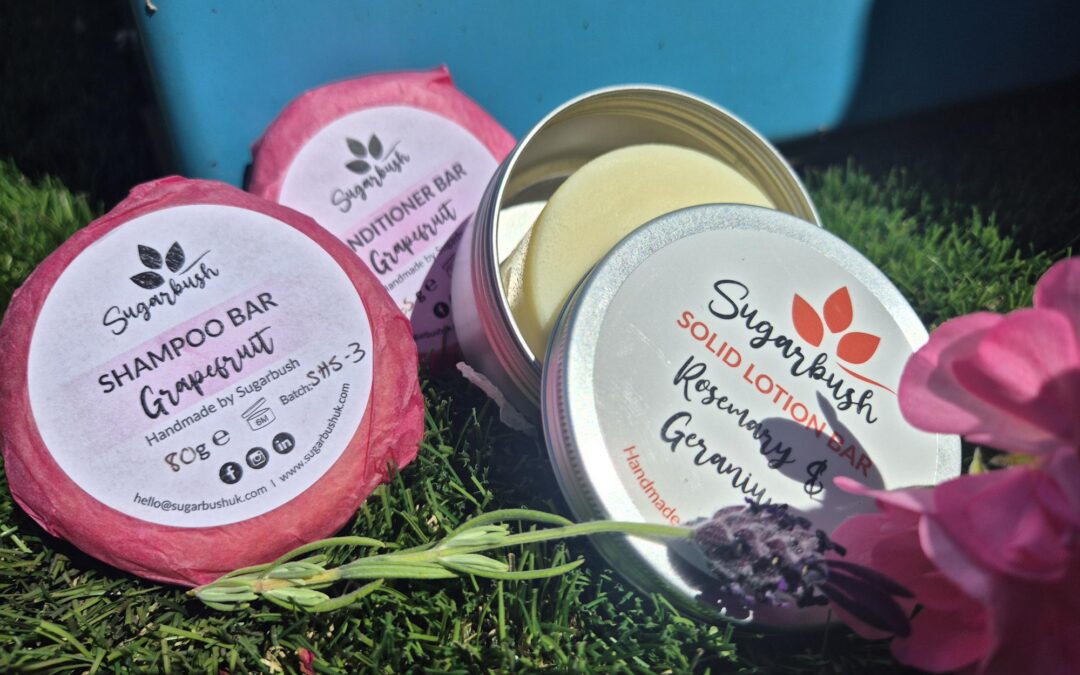
- Sugarbush shampoo bars are a minimum of 80g and give roughly 60 washes, working out at about 22p per wash. That’s based on average use, but everyone’s hair is different. Mine’s long and I wash it 4-5 days a week (I’m a gym girl, so that’s non-negotiable). I sometimes lather twice if it needs a proper clean. Even with that, a bar still lasts me 3-4 months, provided no one else in the family borrows it!
- Conditioner bars are generally applied sparingly to the ends, so a single 65g bar tends to outlast the shampoo bar it’s paired with. A bar will easily last me 6 months. Cost wise, if you assume a similar number of washes, it works out at 15p per wash.
- A lotion bar typically lasts three to six months depending on frequency of use and application area. Because lotion bars are made with plant oils and butters, a little goes a long way. Regardless, it’s a lot fewer trips to the bathroom bin than a 250ml bottle of body lotion.
Swap all three and you can potentially avoid buying around thirty-six plastic bottles over a year (assuming an estimate of one bottle a month for each). That’s not a precise figure (it depends on how much you use), but it gives a sense of scale across three changes.
Why Solid bars Reduce Waste
This bit is about formulation, not marketing. A liquid shampoo or lotion is an emulsion: oil and water forced to combine and held together with an emulsifier. Adding water to a product requires a preservative system robust enough to stop anything growing in it, plus a bottle sturdy enough to hold a liquid without leaking.
All of that adds packaging, weight and cost. A bar skips the water phase entirely, so there’s no emulsion to hold together and no bottle needed to carry it. That’s why solid products create less waste. It’s the combination of no water and reduced packaging, rather than a marketing claim about being ‘plastic free’.
Making Bars Last (So You’re Not Buying More Than You Need To)
The environmental case for items like shampoo and conditioner bars falls apart a bit if you’re going through them in half the time because they’ve been sitting in a puddle of water.
Store them somewhere they can dry out between uses. A draining soap dish, not a flat surface. I ruined more than one bar leaving it flat on a shower shelf before I switched to a dish with proper drainage.
None of this is about willpower. A low waste routine works when it costs you nothing extra to maintain, which mostly comes down to letting bars dry properly between uses.
Where to Start
If you love a particular cleanser, serum or moisturiser and it comes in a bottle, you don’t need to abandon it for the sake of a low waste skincare routine. Chasing every product at once is usually how these things get abandoned within a fortnight.
Pick whichever of the three you buy most often, replace it with a low waste alternative and see how it goes. Then you can introduce another. Those high frequency items are the products doing the most packaging damage over a year, simply through repetition.
If you’re weighing up whether bars are worth the switch at all, I’ve written more on the practical pros and cons of shampoo and conditioner bars here. You can also watch a video on how to use shampoo and conditioner bars here.