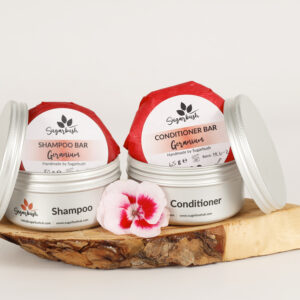
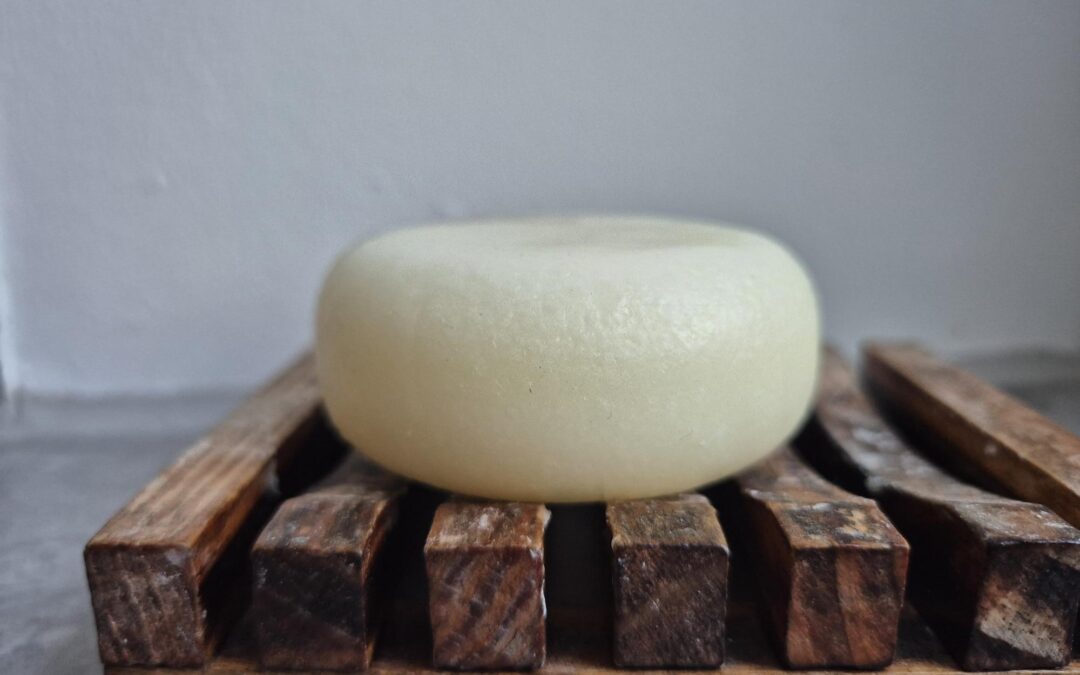
There are two questions that frequently come up when people pick up a conditioner bar for the first time: are conditioner bars suitable for thick hair and in coloured hair, will it fade colour? They’re different questions with different answers, so I’ll take them one at a time.
Why colour is more about the shampoo bar than the conditioner
Colour fade is mostly a washing problem rather than a conditioning one. Hair dye is water-soluble to some degree whatever you use, so every wash loses you a little colour regardless of what’s in the bottle or bar. What changes the rate is the surfactant doing the washing, along with pH and the condition of the hair itself, as a 2009 study in the Journal of Cosmetic Science found. A gentler surfactant system slows the loss, it doesn’t stop it.
A conditioner bar isn’t washing your hair at all, so it was never the part of the routine doing that work either way. Its job is to sit on the hair shaft and smooth the cuticle down, which if anything helps, since a lifted cuticle is what lets colour molecules escape faster between washes.
What thick hair actually needs from a bar
The complaint I hear most from people with thick hair is that they didn’t feel they could use enough of the bar to fully coat the hair shaft. A bottle makes it easy to keep pumping until your hair feels coated. A bar takes more deliberate effort. It needs more passes, more contact time, particularly through the mid-lengths and ends where thick hair usually needs it most.
Warm the bar under water first so it glides rather than drags, then work it directly onto damp hair in sections rather than trying to cover everything in one pass. Thick hair holds product well once it’s there. The issue is almost always getting enough of it on in the first place, not the bar’s ability to condition once it is.
So, a conditioner bar works for both thick or coloured hair.
What’s doing the conditioning
It’s worth saying plainly what’s doing the work here, because the label looks unusual if you’re not expecting it. The first ingredient in a Sugarbush conditioner bar is BTMS, which stands for behentrimonium methosulfate. If you’ve been told to avoid anything with “sulfate” in the name, that name looks like exactly the wrong thing to find in a conditioner.
It isn’t the same family. BTMS carries a positive charge, and hair, especially damaged or coloured hair, carries a negative one. The positive and negative attract, so BTMS adsorbs onto the hair shaft and smooths the cuticle down, which is what gives you the actual detangling and softness. A 2025 study in the International Journal of Cosmetic Science measured exactly this behaviour and confirmed BTMS deposits onto hair through that charge attraction. It’s doing a completely different job to the sulfates in a foaming shampoo, which are negatively charged and built to lift dirt and oil away rather than deposit anything onto the hair at all.
The oils in the bar (jojoba, argan and avocado among them) are doing something else again. They’re emollients, so they soften and add slip, but BTMS is the ingredient conditioning your hair. This is the case irrespective of whether your hair is thick, fine, coloured or not.
Where to apply it
Keep the bar off your scalp (unless your roots and scalp are particularly dry) and concentrate on mid-lengths and ends. In thick or coloured hair, this is where dryness tends to show up first. Applied all over, the richness in this formula can leave finer roots looking oily, since your scalp is already producing its own oils. This is the same guidance I give in the general pros and cons post, it just matters more here, because thick hair needs more product to see the benefit.
The limits
I can’t promise a conditioner bar suits every colour treatment or hair type. Porosity, water hardness and how recently hair’s been coloured all play a part I can’t account for from a blog post. What I can say from formulating these and from what customers report back is that the mechanism holds regardless: a positively charged conditioning agent and an oil-rich bar are, if anything, kinder to colour than most bottled equivalents, and thick hair responds well once it’s getting a proper amount of product rather than a token swipe.
If you’re switching over on coloured hair, give it four to six weeks before judging. A single wash won’t tell you much either way and it takes a few washes for your hair to settle into a new routine.