If you imagine a small skincare brand at work, you probably picture ingredients being weighed, oils being blended or products being poured into jars.
That part certainly exists at Sugarbush but it’s only a small piece of the work involved in creating safe cosmetic products.
Over the past few weeks, I haven’t been making products at all. Instead, I’ve been working on something much less visible – the safety and compliance systems that sit behind every ingredient and every batch. It’s not glamorous work, but it’s one of the most important parts of running a responsible cosmetic business.
Natural skincare is often presented as simple but the reality behind safe formulation is far more detailed. Let me explain…
Natural skincare still requires careful regulation
There’s a common misconception that natural skincare is somehow simpler or less regulated than conventional cosmetics.
In reality, all cosmetic products sold in the UK must comply with the same safety and regulatory requirements, regardless of whether the ingredients are synthetic or naturally derived and regardless of the size of the manufacturer. The legislation that governs cosmetics in the UK and EU is also among the most rigorous in the world and many other regulatory systems are gradually moving towards similar standards.
This means that every product must be properly documented, traceable and assessed for safety. Natural ingredients can be wonderful to work with, but they still need to be used thoughtfully and responsibly. “Natural” should never mean casual.
Ingredient documentation and traceability
One of the key parts of cosmetic compliance is traceability.
Every skincare product that makes it to market starts with a formulation…a recipe for a product that helps you with your skin, maybe to lock in moisture. This can take months of experimentation and testing before a business is satisfied with the result. This is the bit most small-scale makers like me enjoy most – chemistry with a twist. Although there’s a fair bit of maths in there too to ensure the ingredients are in the right proportions, the essential oils are within safe limits and that any allergens they contain are calculated ready for producing labels.
Once a formulation is complete and working well, the real compliance work begins. The product formulation then needs to be assessed by a cosmetic scientist for safety. They assess the overall safety of the formulation and its intended use, consider the safety documents associated with each ingredient and check the formulation complies with cosmetic safety regulations. Once satisfied, they create a Cosmetic Product Safety Report (CPSR). The formulator can then get to work on creating labels that list all ingredients by INCI (International Nomenclature of Cosmetic Ingredient) name, including any allergens that need to be declared.
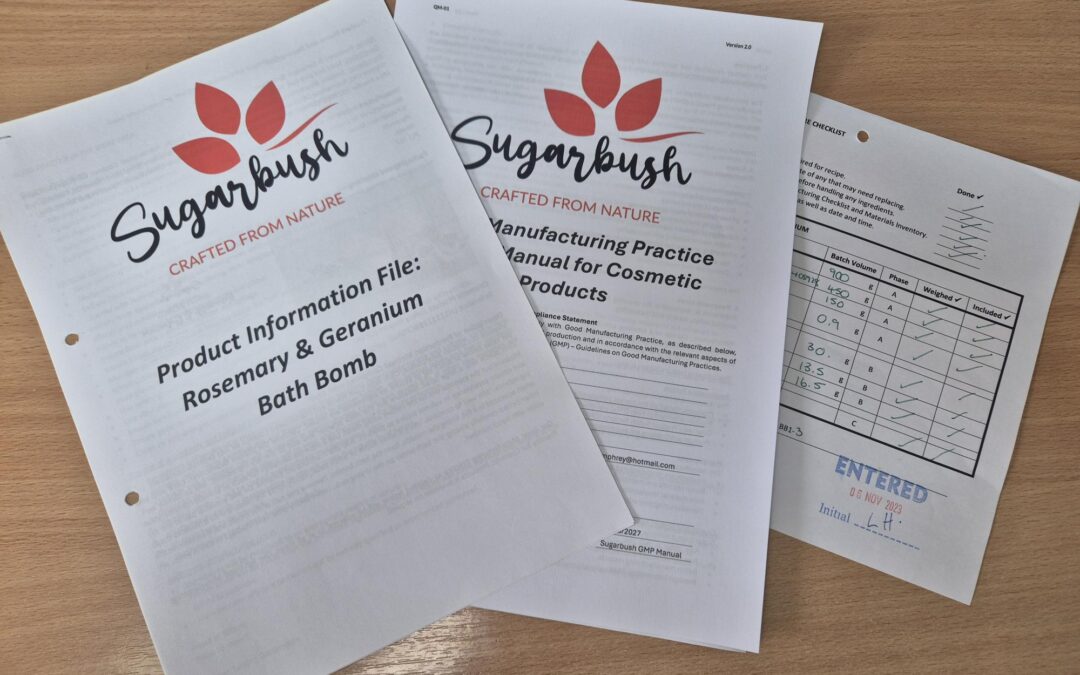
Alongside the CPSR, the formulator must create a Product Information File (PIF), one per product. For Sugarbush, that means I have written 52 PIF documents so far! The CPSR forms one section of each PIF but it also needs to have:
- A product description.
- Images and labels of the product.
- Manufacturing method.
- Good Manufacturing Practice (GMP) statement. At Sugarbush, every PIF has a GMP statement but I also have a more comprehensive document that outlines my Good Manufacturing Practice in detail. This is just one document in my compliance system.
- Proof of any claimed effects. In general, skincare manufacturers are not able to make claims about a product healing, curing, treating and reducing skincare conditions unless they have scientific data from tests that support those claims.
- Animal testing. At Sugarbush, we do not and never will test our products on animals.
I use this data to then submit a cosmetic product notification on the Government portal.
Building a cosmetic compliance system
The biggest bulk of admin comes in step three – building the compliance system that documents both the ingredients used in each product and the way those products are manufactured. I had a system in place long before Sugarbush launched but recently, I’ve been working through everything from raw material records to standard operating procedures.
Organising raw material records
I’ve refined my raw material records and implemented new systems to improve the way they’re documented, stored and managed. It forms a key part of ensuring every ingredient can be tracked through the entire process, from supplier to finished product.
For every ingredient used in a product, the following is recorded:
- Supplier.
- Supplier batch number.
- Expiry or best before date.
- Safety documentation – safety data sheets, allergen declarations.
- Date the ingredient is received.
- Date the ingredient was first opened.
- Where it was used in production – these appear in the product batch log.
If a problem ever occurred, this system ensures the source could be identified quickly and responsibly. It’s detailed work, but it’s the foundation of good cosmetic manufacturing practice.
Batch records
Alongside ingredient records, each batch of product needs its own documentation.
Batch records allow me to track:
- exactly which ingredients were used.
- the quantities used in each batch.
- the date the product was made.
- environmental conditions during production.
- where the batch was distributed.
There is a lot more that exists within the compliance system, but these are the main ones. For a small business, this can feel like a lot of paperwork and reviewing everything can sometimes feel overwhelming. At Sugarbush, it’s essential for maintaining quality and accountability.
Why this work matters
Natural skincare often celebrates the beauty of ingredients, but responsible formulation also requires structure, patience and careful documentation. It needs systems to ensure products are safe, consistent, traceable and responsibly produced.
One of the reasons I value small-batch production is that it allows close control over ingredients and processes. We make every batch carefully, record the details properly and review the process along the way. It may take longer than large-scale manufacturing, but it creates a level of attention that I believe matters.
And while most of it happens quietly behind the scenes, it’s an important part of how Sugarbush operates.
A note on training and cosmetic compliance
Alongside developing Sugarbush, I have also completed formal training in skincare formulation. I’m currently completing my first diploma through Formula Botanica, with two further diplomas still to follow.
This training builds on my existing knowledge of cosmetic ingredient safety, regulatory compliance and responsible formulation practices. Continuous Professional Development is essential to building a strong foundation for Sugarbush – it shapes the way I approach ingredient selection, documentation and the systems that sit behind every product.
How does this affect you?
All of this work – the documentation, the ingredient traceability, the batch records, the systems – exist for one reason. So that every product leaving my workshop is something I’m comfortable putting my name on.
When you pick up a jar or tin from Sugarbush, you’re seeing the final step in a much longer process. It may not be the most visible part of skincare, but it’s one of the reasons small-batch products can still be made responsibly, transparently and professionally.
If you’d like to explore the current Sugarbush range, you can browse the collection here: https://sugarbushuk.com/shop/