
Packing natural travel skincare used to mean decanting half the bathroom into little 100ml bottles and hoping none of them leaked before baggage reclaim. Mine leaked. A cream facial wash and a shower gel both worked their lids loose in the same wash bag and everything in there came out coated. Now, I don’t travel with liquids if there’s a solid alternative to hand.
Why solids skip the liquids rule entirely
At most UK airports, anything that spreads, pours, sprays or smears counts as a liquid for security purposes. If it’s a liquid, it has to fit in a container of 100ml or less in your hand luggage. A solid lotion bar, shampoo bar or balm avoids this drama because they’re a different physical form altogether. As a result, bars and balms usually go through security without issues.
Rules do vary by airport. Heathrow, Gatwick, Edinburgh and Birmingham have all swapped the 100ml limit for a two-litre one for bags going through their newer scanners. More airports are being signed off as their equipment clears government checks. If you’re jetting off, it’s worth checking both your departure airport’s website before you go and your return one. Annoyingly, the two won’t always match. None of that changes anything for solids though since they were never a problem in the first place.
Can you take a shampoo bar in hand luggage?
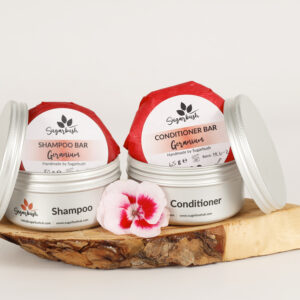
Yes. A shampoo bar isn’t a liquid, gel or aerosol, so it doesn’t count towards your allowance and doesn’t need to go in the clear bag. The same goes for the rest of my natural travel skincare: conditioner bars, lotion bars and lip balm tins. Security might want a look inside a tin, as they would with anything metal, but there’s nothing stopping you taking one. I’ve never had a bar questioned, though I’ll admit I don’t fly all that often.
What natural travel skincare looks like in a suitcase
My wash bag is a fraction of the size it used to be since I started making my own solid cosmetics. The biggest saving comes from natural travel skincare that does more than one job, so it is worth looking at what you use and asking whether a single product could serve more than one purpose.
Some top tips…
- A lotion bar does body and hands. A shampoo bar and conditioner bar do hair. If space is tight, the shampoo bar will do for the body as well. A conditioner bar also gives enough slip to act as a shaving cream. A lip balm tin does lips, cuticles and the dry patches my kids’ elbows end up with after a week in and out of the sea.
- Get travel tins for the haircare bars and keep them together in a small pouch. Bars left loose in a wash bag pick up fluff and usually end up broken.
- Size the bar to the trip. A full-size Sugarbush shampoo bar gives around 60 washes, so a fortnight away barely touches it. Cut one in half and leave the rest at home or take a whole one and let everyone share. You can do the same with a conditioner bar depending on how many people will be using it.
- Are there swaps you could make before you travel? I use a solid deodorant bar along with my regular solid cosmetics.
Why heat matters less than you’d think
Solid bars made from plant oils, butters and waxes aren’t heatproof. I left a lip balm in a bag in the car during a heatwave and came back to a tin of liquid. It was sealed, so nothing was lost and it set hard again once it cooled down. It’s worth knowing that a softened bar or balm sets again. A cream or lotion that gets hot enough to split won’t reset because, once the water and oil have separated, the structure of the emulsion is broken. In fairness, any facial cream you’ve bought will have been through stability testing to check the emulsion holds across a range of temperatures. So it’s a caution rather than a certainty.
The numbers are more forgiving than people assume. The beeswax I use melts somewhere between 58 and 65°C. Cocoa butter goes at about 30 to 35°C, which is roughly skin temperature. This is why a lotion bar melts as you rub it in. When I’m making a batch, everything except the vitamin E and essential oils gets taken up to 70°C so it all combines properly. A suitcase pocket out of direct sun won’t come close to any of that in most places. A hot climate narrows the margin. A car left in full sun is where it actually becomes a problem. There’s more on storing wax and butter-based products in warm weather if you’re off somewhere hot and considering taking a balm-type product.
Getting a wet bar home again
Packing to go is easy. Packing to come home needs a bit more thought and it’s the part of natural travel skincare that catches most people out. A shampoo bar that goes into a sealed tin still wet from that morning’s shower carries on softening and dissolving all the way back.
I wash my hair the night before I travel and leave the bars out to dry overnight, then pack them in the morning. That gives them plenty of time to air properly. If that’s not an option, tip any water out of the tin and leave the bars as long as you can before they get stored. Then get them out again as soon as you’re home and let them dry off fully.
What still has to go in the liquids bag
Natural travel skincare doesn’t empty the liquids bag completely. Your facial skincare might have a facewash, toner, moisturiser and possibly a facial oil for nightime. If your holiday is abroad in a hot country, suncream is another obvious one. I don’t make it and I wouldn’t want to improvise with anything that hasn’t been through proper SPF testing, so mine goes in a bottle like everyone else’s. Toothpaste counts as a liquid too, and so does anything in a spray, deodorant included, unless you’ve swapped to a solid.
What changes is how full the bag is. Take four people’s shampoo, conditioner and moisturiser out of it and there’s suddenly room for the things that have no solid version.
Where this fits into the rest of your routine
Natural travel skincare is your usual solid routine, minus the decanting. My lotion bars run three to six months of regular use, and haircare bars will survive a fortnight away with barely a dent. If you’ve already made the switch at home, packing for a holiday means taking what you already use. If you haven’t, a holiday is an easy place to start, if only because you’ll be stood in a security queue thinking about it anyway.